• Zur Hauptnavigation springen
  • Zum Inhalt springen
  • Zur Fußzeile springen
  • Index
  • Contact
  • Imprint and Legal Notice

Faule Haut

A Circumnavigator‘s Yacht

  • The Yacht
  • Cruising Plan
  • de_Blog
  • en_Blog
  • Mitsegeln
  • Paraphernalia / Fan-Artikel
  • Position Report

Ingo

Almost

4. Februar 2020 von Ingo Kommentar verfassen

Faule Haut’s Skipper Ingo is keen on leaving Barbados and to come to circle. He’s is only 110 nautical miles away from Martinique where he started his circumnavigation.

Almost complete

In a few days you will have to add his name. Rewrite the history books:

Christoph Columbus, Ferdinand Magellan, Vasco da Gama, Amerigo Vespucci, Skipper Ingo

Kategorie: Allgemein, en_Blog

Barbados

3. Februar 2020 von Ingo Kommentar verfassen

SY Faule Haut has reached Barbados, Caribbean, Feb. 2, 2020.

The last leg was her longest one ever. Leaving  Cape Town, South Africa on Dec. 15, 2019 it took her 49 days to reach Barbados after sailing over a distance of 5,350 nautical miles.

5,350 nm Cape Town to Barbados

Skipper Ingo and crew Immanuel (who came on the boat at Durban, South Africa) dropped the anchor at Bridgetown, Barbados on Feb. 2, 2020 right after sunrise.

Reaching South Africa, after going through some nightmare experiences south of Madagascar, Skipper Ingo wasn’t afraid of anything anymore. He knew, that the worst was over. He was laughed at, when he said to his skipper friend Warren, that he  expected the Atlantic Crossing to be a “walk in the park”.
But it was exactly that. It was an easy cruise with neither storms nor bad weather nor bad waves nor bad whatsoever. And – having crew Immanuel on board – it was a lot more relaxing sailing, especially during the night. We shared the night watches. I was in charge until five o’clock in the morning and then he took over.

A great blessing was our whisker pole, that we luckily found and bought on the very last day in Durban. The first consecutive 15 days we had light winds from astern when we used it continuously. I estimated that this shortened our passage of about three or four days.

Well – not everything went smooth. Too many things broke during this passage, things that are costly to repair or to replace:s

The genoa furler got stuck – more precisely – the halyard swivel on top. We had to climb up the mast three times to get it working. Here I have been lucky that I was not singlehand sailing but had crew Immanuel on board. Going up the mast with both sails hoisted in the middle of the Atlantic on a rocking and rolling boat is no fun and doing this alone is even worse. Being two on board, one could use the winch to pull the other one up to the top. Climbing up there alone is more than a PITA.

The genoa halyard got entangled inside the mast with the VHF-Antenne cable and tore it apart. Replacing this, is very complicated because that cable runs almost through the entire boat from the navigation table up to the antenna on top of the mast.

My inverter 12 V/230V went up in smoke – unrepairable.

After that, the genoa got torn when we were right between Africa and South America.  It started with a little tear/crack of about 20 cm.

Genoa gets torn

We wanted to patch it, but the tear was to high to reach to. At that time we had winds between 20 and 25 knots, – too high to get the genoa down from and off the furling system. We had to wait for the winds to calm down. Unfortunately it took a week for the winds to get down to about 10 knots. This was short before we reached the doldrums zone. By then, the tear had expanded to almost one meter length.

Too long torn to sew.

So we took the genoa off to patch (sew) it. But we soon noticed, that it would take an entire day and we decided to hoist the spare genoa. I was well prepared tor this circumnavigation and carried a spare genoa as backup.

Hoisting the spare genoa

After two weeks sailing with this second genoa, it started to get three little tears as well. But here they were in the lower section so we were able to reach and patch them with duct tape, without having to take it off the furling system. We were scared first, that the patches were efficiently stopping the tears from getting bigger. But it worked.

The leaking shaft seal on the motor hasn’t  been replaced yet and the leaking got worse, when the motor was running. When we were motoring through the doldrums for about 58 hours, we had to pump saltwater out of the motor bilge every two hours, day and night. That was a big nuisance. Wisely though, I had an electrical mobile pump on board which made this job easier.

The worst thing (because most expensive) however is, that my battery house bank is toast – broken – like the inverter. They don’t hold the charge any more. We had to shut off the fridge in order to keep the auto pilot running. They get charged during the day by the solar panels close to 13 volts, but during the night they drop down fast to 11 volts. Amazing, that the auto pilot was content with that low voltage and didn’t refuse to work.

It was a bank of three 220 Ah GEL batteries, 660 Ah all together. I expected them to last longer, but if I look back I have to admit that I used them extensively. The fridge running 24/7 plus heating the water for tea and cooking (via the inverter) every day means a daily charge and discharge which all sums up to about 800 charge/discharge cycles over a period of two years and three months.

Repairing the two genoas and replacing the battery house bank and the inverter will be a big kick in the wallet. Since I’m broke and busted, I don’t know how to finance that. Looks like I need to find a job in the Caribbean to make it back home. Luckily, I will get some friends soon on board here who contribute a little to my immense costs.

One of the toilets broke down as well and needs to get fixed.

The winch on the starboard side has to be taken apart and cleaned. It doesn’t work anymore. I hope it’ll work again after cleaning. Luckily – since, this winch quit working – we were sailing only one port tack, so we didn’t need this one on the starboard side. I have to wait to be at anchor to take it apart for cleaning. Too much movement while sailing on the Atlantic.

The anchor switch is broken and has to be replaced.

Two windows are leaking and need to get sealed.

A door look is broken and needs to be replaced.

Three covers of the batten pockets on the main sail are torn off and have to be sewn on again.

Two genoa’s have to be patched now. I need a professional sailmaker to do that. And these guys like to rip you off, knowing that you depend on them.

I’m happy to be ashore again, after being on the Atlantic for 49 consecutive days, but there are a lot of costly repairs to be done. I know I said that before but here it comes again: „CRUISING IS BOAT REPAIR IN EXOTIC PLACES.“

After having met over hundred other skippers on my cruise who made the same experience, I found some consolation when we shared our experiences and they said: “We are repairing around the world.”

Geography/meteorology lesson:

In case you want to know why our track through the Atlantic hasn’t been like a straight line but has two curves, here is the explanation:

All around the world, close to the equator runs a “belt” which is called the Intertropical Convergence Zone (ITCZ). As you know, the hottest place on earth, you will find close to the equator. As the surface temperature increases at the equator, it heats the air above. The warm air rises and expands, which lowers the air pressure at the surface, creating a “vacuum” close to the surface of the earth or (in this case) over the ocean. This “vacuum” has to be filled and will be filled by air flowing towards the equator. Another word for this “air flow” is wind. From the area south of the equator, the wind is flowing/blowing towards the north. From the area north of the equator, the wind is blowing south. And since the earth doesn’t stand still but is turning, the wind is diverted. This diversion is known as coreolis (Coriolis Kraft) and creates the “trade winds” (Passat Winde). They got there names from the fact that the first sailing trade ships made use of these winds to trade/transport their goods over the oceans. North of the equator the trade winds are blowing from the north-east, south of the equator from the south-east (see map)

The Doldrums

You see that north of the equator runs another belt with calms parallel to it around the earth which is called “horse latitudes” (German: Rossbreiten). A funny name!? Yes! They got this name because once there was a flotilla of sailing ships that got caught in these calms for weeks and the crew was starving to death when finally they decided to throw the horses over board to lighten the ship and save water and food.

Because of different land masses spread over the earth, the ITCZ is not running as a straight line. Neither does it have the same width. The width varies between 100 and 300 nm. In the area where we were sailing, crossing the equator, the ITCZ, or the doldrums/calms are between 200 and 300 nm wide, roughly, depending on the time of the year and some other factors. According to the “Pilot Charts” ( a collection of maps with weather patters all over the world), we knew, that the doldrums belt would be at its smallest/narrowest between longitude 25° and 30°, a little bit north of the equator. And we knew, that there wouldn’t be any winds blowing in the doldrums. We knew, we would have to cross the ITCZ motoring, and that we would have limited fuel on board which only allows us to motor less than 300 nm. Therefore we aimed for the spot, where the ITCZ is at its smallest AND we crossed this zone in a RIGHT ANGLE (else it would have been a longer distance). If you can’t get out of the doldrums by motor, you might get stuck there for weeks or even months. So to us, it was important to know all this and act accordingly.

Bridgetown – the Capitol of Barbados

A clean white sandy beach.
At our beach


In Bridgetown

Skipper Ingo on SY Faule Haut, currently anchoring in paradise, Carlisle Bay, Bridgetown, Barbados, Caribbean.

Enjoying to be able to sleep like you landlubbers: No night watches, no heeling, no rolling, no alarms from the clock nor from the auto pilot, no reefing, no adjusting of sails or course in the middle of the night.

Kategorie: Allgemein, en_Blog Stichworte: Barbados

Atlantic Crossing Again

15. Dezember 2019 von Ingo Kommentar verfassen

Faule Haut with Skipper Ingo and Crew Immanuel have left Cape Town, South Africa towards Martinique, an Island in the Caribbean that belongs to France.

Distance: 5,400 nm

Travel time: 53 days

ETA: 06.02.2020

4 carts! Enough food for eight weeks?

Fuel, water and food are stocked. If we don’t get stuck in the calms we ought to arrive as planned.

We are having a good start. Sun is shining and we also have enough wind. This is our last view of Cape Town with its famous „Tafelberg“, Table Mountain.


Kategorie: en_Blog

Docked at Cape Town

12. Dezember 2019 von Ingo Kommentar verfassen

Docked at Cape Town

Reaching Cape Town, South Africa on 12.12.2019 09:45 local time

After leaving Réunion on the 8th of Nov. 2019 her Skipper Ingo knew, that a tough passage would be coming up. But it exceeded his expectations. But all this is a thing of the past now. He is happy up to the max., that he could pick up his crew Immanuel in Durban and sail with him safely to Cape Town where they arrived this morning.

The first two days from Durban on where difficult and they were facing high winds twice up to 45 knots but afterwards, they where in good weather and had a calm and easy cruise to Cape Town.

The boat is tied up at the port of Houtbaai, Cape Town, South Africa now.

Unfortunately, the crew can only stay there for three nights, before heading to the Caribbean, because Immanuel had booked his flight from Martinique to Germany already, they have to reach Martinique on the 7th of February 2020. This deadline gives them 53 days for the passage to the Caribbean. So they have to move on to make it in time.

Some repair jobs have to be done on Faule Haut and provisioning for the Atlantic crossing is due. Too sad, there will only be little time for sightseeing.

Especially the skipper is looking forward to having a few nights of good sleep, like you landlubbers can enjoy every night.

Praise the Lord for his protection on this unforgettable passage.

You have got to watch these seals. They even try to sneak on your boat, like this on on a neighboring catamaran.


Kategorie: Allgemein, en_Blog

Under Radar

12. Dezember 2019 von Ingo Kommentar verfassen

12.12.2019 09:18 local time

Two nauticle miles left to reach our port in Cape Town we experience this: fog.

Visibility under 100 m. We were scared to run into other boats coming out the port.

For safety, I turned the radar on

Kategorie: Allgemein, en_Blog

Around the Cape

11. Dezember 2019 von Ingo Kommentar verfassen

11.12.2019 13:20 local time

Sailing round the Cape right now. Faule Haut is just going round the southernmost point of South Africa.

Cape Agulhas, South Africa

BUT – it is not Cape of Good Hope, as most people think. The southernmost point is Cape Agulhas. She has 108 nm left to go to Cape Town.

The last two days it was perfect sailing. She is making over 5 kn of speed and should reach Cape Town tomorrow afternoon. Skipper Ingo and Crew Immanuel are in high moods.

Kategorie: Allgemein, en_Blog

Crew Caught Fish

10. Dezember 2019 von Ingo Kommentar verfassen

While we are sailing along the South African Coast, with 254 nm left to go to Cape Town, Immanuel caught a tuna this morning right in time for breakfast.

A good start

It wasn’t such a big one, but definitely enough for a meal for  two. Delicious tuna steaks.

Yum-Yum

Shortly after that, he had a bigger fish on the rod, but unfortunately the line broke and we lost line, lure and hook

Kategorie: Allgemein, en_Blog

Out of Danger

9. Dezember 2019 von Ingo Kommentar verfassen

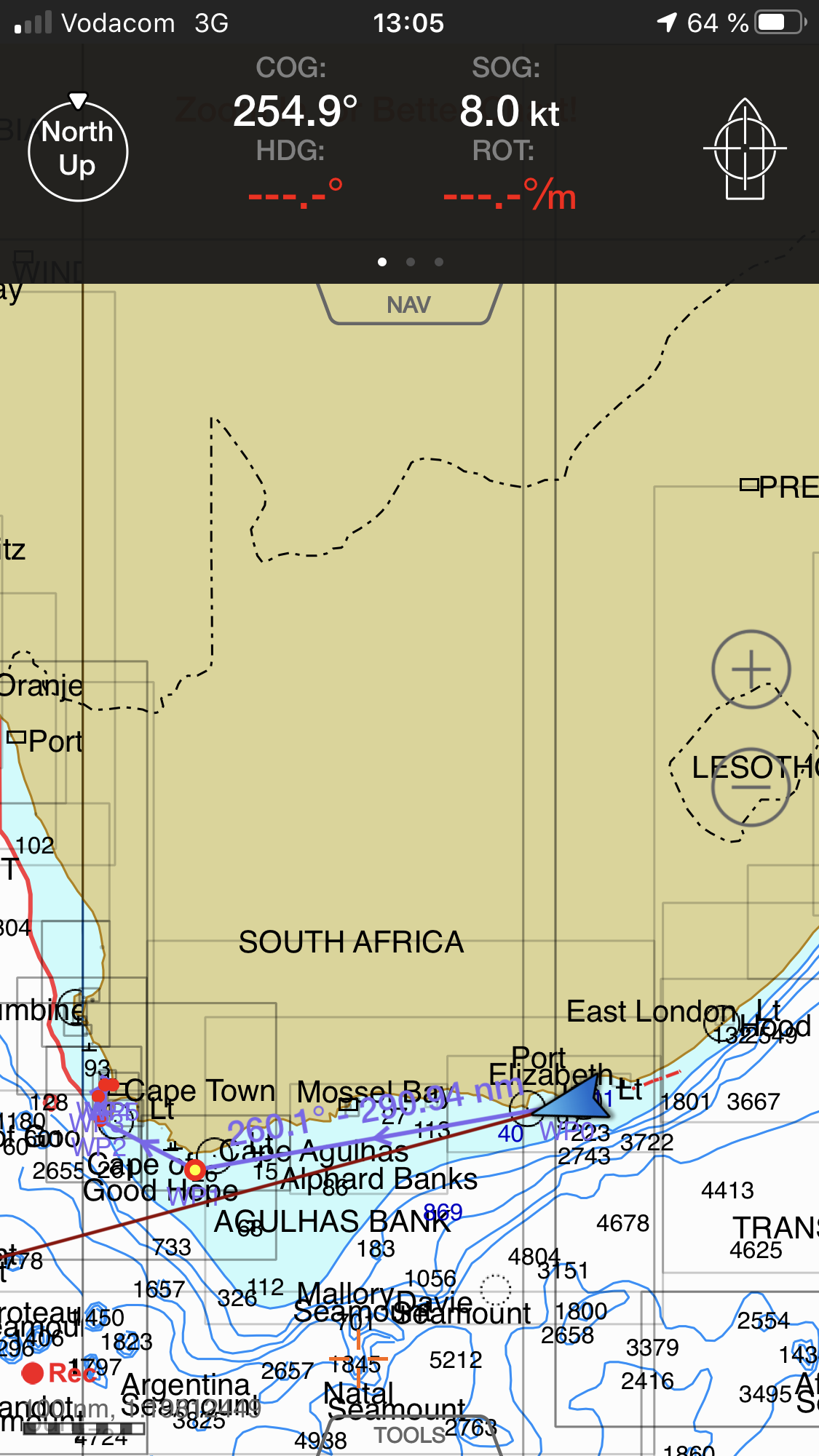
Faule Haut has passed the most challenging leg on her circumnavigation – the Mozambique Channel and the South African Coast between Richard’s Bay and Port Elizabeth.

She is just speeding along the South African Coast, making 7.3 knots, and has just past Port Elizabeth.

South African Coast

What comes now, will be a walk in the park compared to what she experienced within the last three weeks.

A great relief for Skipper Ingo and Crew Immanuel.

The forecast look as good as never before, which means a safe cruise from now on is expected.

Thank God for his protection through a bunch of ordeals.

There are 405 nm left to their next stop, which will be Cape Town, and they should get there in less than four days.


Kategorie: Allgemein, en_Blog

Regrets

7. Dezember 2019 von Ingo Kommentar verfassen

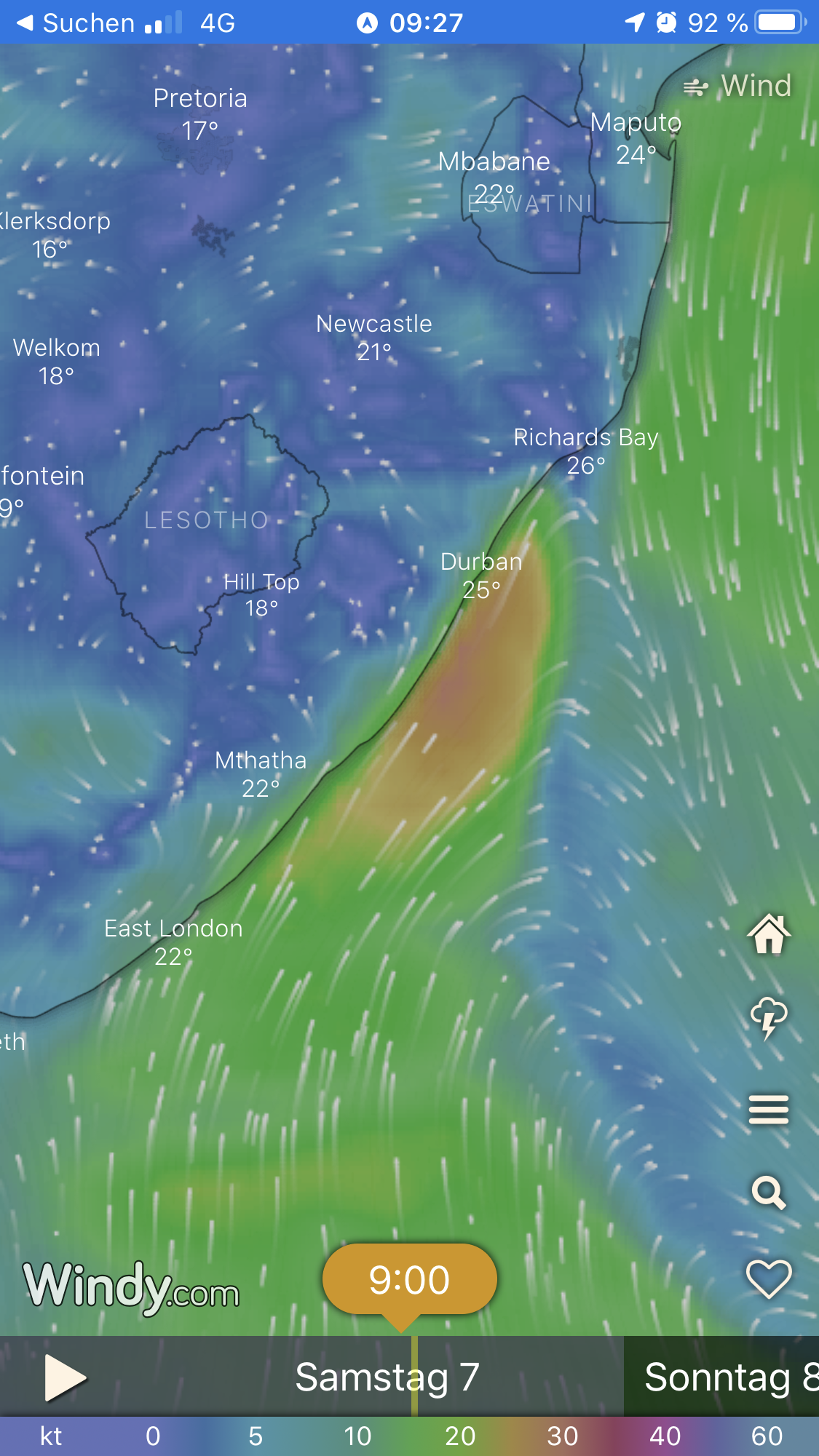
Cruising along the South African coast about 80 nm south of Durban, I just received this email from my weather guru Des.
That man can read my mind:

„Dear Ingo
I am sure by now you are having some regrets about being out there…“

That guy is so darn right.

My answere to him tells you what we are in right now:

„Hi Des, you can read my thoughts. And you do know the weather well.
I knew it was gonna be tough, but I didn’t expect it to come that bad. It’s even worse than WINDY is showing in their forecast.

Being right in it. I’m  in 44 kn of wind with gusts up to 54.

High waves and uncomfortable swell. This is between purgatory and hell. But what am I talking – you know all that.
It’s good that I have cell phone connection so I can get the forecast. According to WINDY the wind should go down from noon on. Slowly – but that will be a relief. They better not lie to me.
A big wave flooded the cockpit 15 Minutes ago and I was soaking wet and just changed my clothes…“

Sailing is bad, when you are tied up to a schedule. This will be a loooooong day.

Kategorie: Allgemein, en_Blog

Leaving Durban

6. Dezember 2019 von Ingo Kommentar verfassen

Leaving Durban with ne crew. Faule Haut Skipper Ingo is in top mood.

New crew Immanuel

I picked up my new crew, Immanuel, yesterday, a young but experienced sailor from Germany who will join me across the Atlantic up to the Caribbean. This will make the cruise a lot more interesting and entertaining and most likely less dangerous as well. He is a very sympathetic guy and we both are looking forward to the upcoming experience.

Immanuel has been a great help this morning already, when he fixed a disattached step on the companionway, which was not an easy task, because of the little access space in the motor compartment.

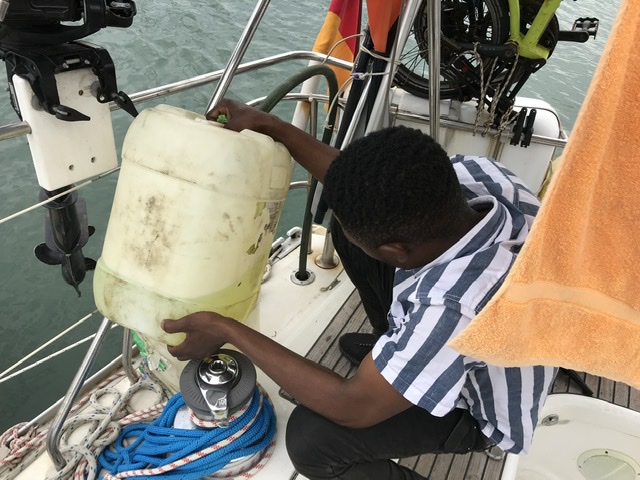
Shortly after that we got 100 liter diesel delivered to the boat.

Fueling up by jerry cans.

It’s almost unbelievable: Durban is a huge port with hundreds of boats, but they don’t have a gas station for the pleasure craft. All fuel has to be carried to the boat by jerry cans. Same as I experienced in Indonesia.

A strong black guy came to the boat an asked for a job. He offered to clean the entire hull for just 400 South African Rand (26,- € or 30,- $US)

This came in handy, because it was full of barnacles again. I had the intention to do the cleaning myself once we reach Cape Town, but for that low price I decided to let him do it. This helped both of us.  That fellow did a great job and Faule Haut is clean now and ready for the Atlantic crossing.

But first we need to get to Cape Town. We are still sailing along the South African Coast in the Agulhas current where it is extremely dangerous if the weather is not playing right for you.

We left Durban two hours, ago and rIght now we are having good winds from astern.

Tomorrow it’s supposed to change and we will be facing southerly winds which will be very bad for us. But according to the forecast, this should only last for about one day. On from tomorrow morning we’ll be having a pretty uncomfortable cruise.

All the other boats here that are heading for Cape Town are waiting for Sunday to leave, but because we are already 9 days behind our schedule we decided to start today. Up to East London there will be no shelter along the coast, so we hope the weather won’t get to rough.

Kategorie: en_Blog

  • « Vorherige Seite aufrufen
  • Seite 1
  • Weggelassene Zwischenseiten …
  • Seite 7
  • Seite 8
  • Seite 9
  • Seite 10
  • Seite 11
  • Weggelassene Zwischenseiten …
  • Seite 18
  • Nächste Seite aufrufen »

Footer

Blogroll

  • Deutsches Blog
  • Heimathafen

Urheberrecht © 2026 · News Pro An Genesis Framework · WordPress · Anmelden